
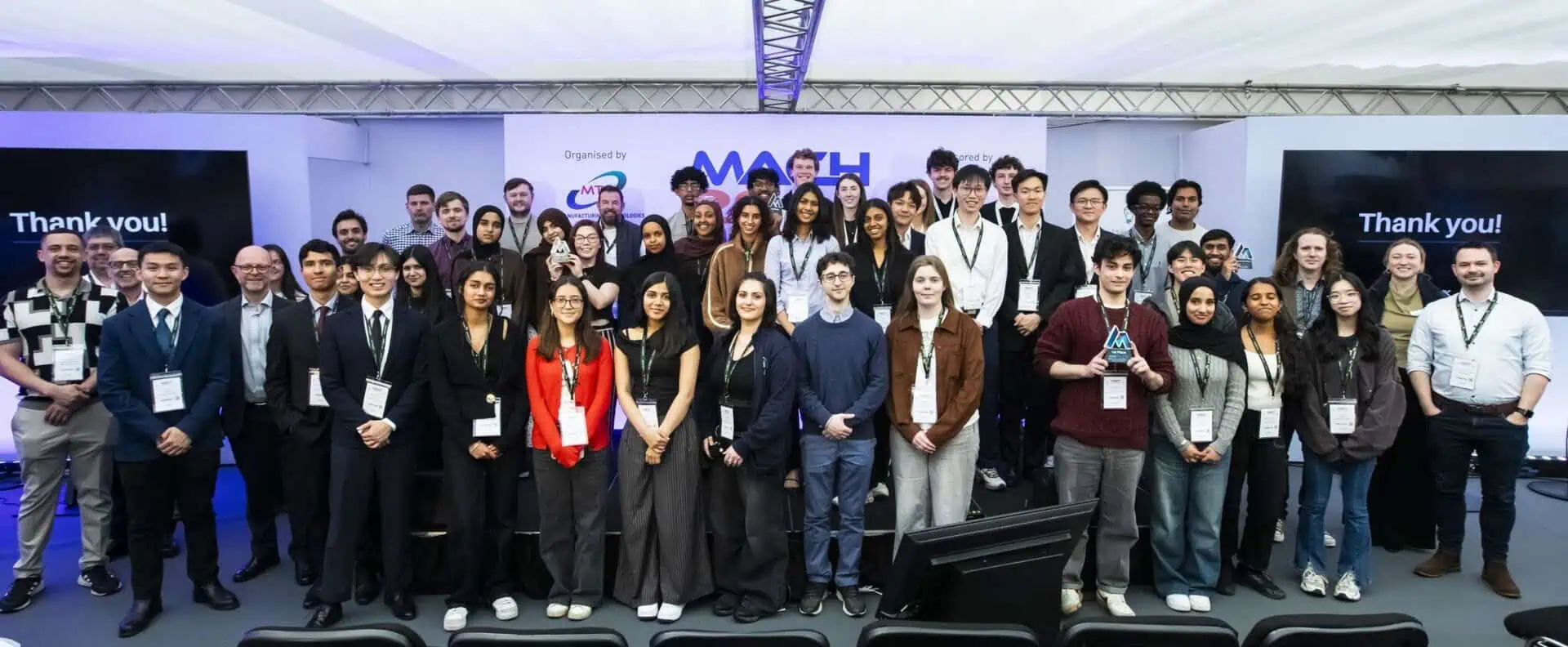
At the AMplify Impact Challenge Grand Finals, student teams presented bold ideas to improve Additive Manufacturing – showcasing innovative solutions focused on sustainability, circularity, and resilience.
Additive Manufacturing offers promising opportunities to reshape how we design and produce products and solutions – from reducing material waste, to supporting localised production and more responsive supply chains.
But those opportunities don’t automatically translate into positive outcomes. As the world around us continues to change, so too must the technologies we rely on. Questions around where machines are made, who has the skills to use them, and how materials are sourced, used and disposed of, all point to a need for continued evolution within the sector.
In this year’s AMplify Impact Challenge, student teams turned their attention to this very topic. Delivered in partnership with Additive Manufacturing UK (AMUK) – and sponsored by the Advanced Machinery and Productivity Institute (AMPI), GKN Aerospace, Alexander Daniels Global, 3D 360, BWT Alpine and Stratasys – the Challenge asked teams to explore how Additive Manufacturing technologies can be made more globally responsible across their full lifecycle – focusing on themes such as sustainability, circularity and resilience.
“AMplify brings together two things that the MTA and AMUK care deeply about, developing the next generation of engineers and demonstrating how manufacturing technology can deliver meaningful societal impact. Working with Engineers Without Borders UK has allowed students to tackle real challenges using Additive Manufacturing.”
Joshua Dugdale, Head of Additive Manufacturing UK
Earlier this April, the competition came to a fitting finale with a Grand Finals event taking place during the MACH 2026 exhibition at the NEC in Birmingham.
The Challenge
Launched in late January, AMplify was designed as an extra-curricular, student-driven competition. Following an open call, over 200 students from the UK and Ireland joined the Challenge, working in small teams to devise concepts with the potential to reshape industry.
After an initial round of reviews from a group of Additive Manufacturing experts, the top 10 teams were paired with industry mentors to further develop their solutions before heading to the Grand Finals in Birmingham. There, they met leaders from across the sector and competed for the top prize, which included a tour of the Alpine F1 factory.
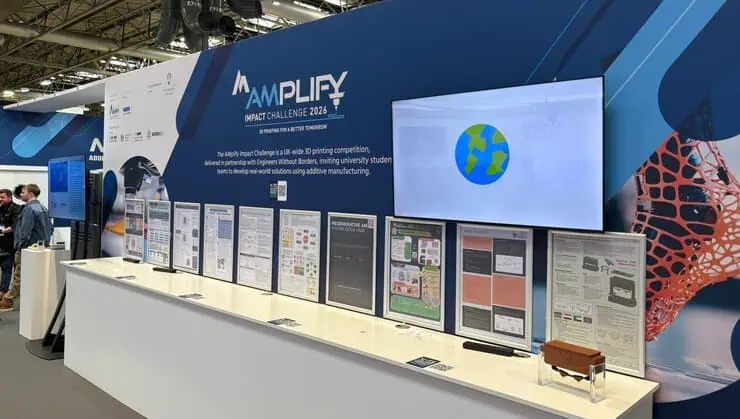
The top ten teams’ posters on display
The event comprised two stages: a morning pitching session featuring all top teams, followed by an afternoon final in which four teams presented to a panel of industry judges.
We were also honoured to be joined by Minister for Skills, Jacqui Smith, who opened the event, recognising the role that initiatives like AMplify play in helping future engineers develop the essential skills needed to tackle 21st century challenges.
“The AMplify Grand Final demonstrated what’s possible when young engineers explore Additive Manufacturing with a globally responsible lens. Our top teams did this with extraordinary creativity and empathy. We’ve been proud to work alongside AMUK in bringing this new challenge to life and supporting the next generation of engineers who will shape a fairer, more sustainable future.”
Tim Wilson, Universities and Partnerships Lead, Engineers Without Borders UK
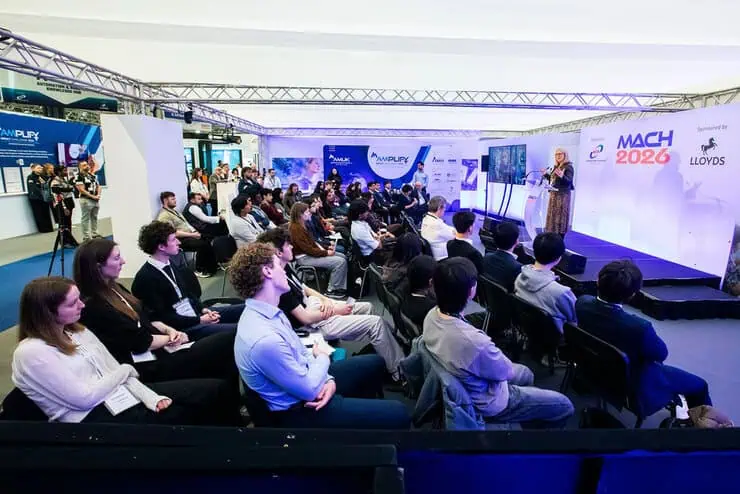
Minister for skills Jacqui Smith opens the AMplify Grand Finals. Photography by Karla Gowlett
Introducing the winning teams
First place and People’s Prize: Team 52 – Queen Mary University of London
Taking home the top prize was Team 52 from Queen Mary University of London. Their proposal tackled a pressing issue in Additive Manufacturing: the waste generated by PVA support material during printing.
Drawing on their experience with 3D printing in a Formula Student competition, the team had seen first-hand how much material is lost during design and prototyping. In response, they developed a three-stage recovery system – combining dissolution, evaporation and filtration, and extrusion – designed to reprocess waste PVA back into usable printing filament.
The result is a solution capable of returning up to 60% of discarded material into the printing cycle, reducing both waste and resource demand.
Judges were particularly impressed by the team’s attention to detail, including consideration of wider system impacts such as improved wastewater quality, alongside a clear application of circular design principles.
“AMplify gave me the opportunity to take an idea I believed could make a difference and develop it into something real. The experience of refining the concept, receiving expert feedback, and presenting to such a knowledgeable panel has been invaluable. Winning is something I still can’t quite believe, but more than anything it has given me the confidence and motivation to keep pushing this idea forward.”
Russell McDonnell, winning participant, Team 52
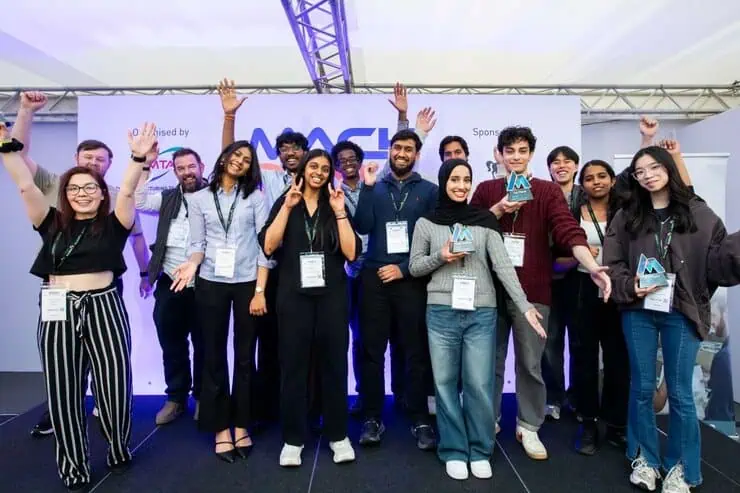
The winners of the AMplify Impact Challenge 2026. Photography by Karla Gowlett
Second place: University of Sheffield
Team 1 from the University of Sheffield came in a close second with their biodegradable filament concept made by combining PLA with locally sourced wheat husk fibres – tackling the limitations of conventional “biodegradable” plastics that rarely break down outside industrial conditions. The new material enables faster natural degradation while maintaining similar performance to standard PLA.
Third place: The Open University and University of Nottingham
Impressed by the strength of all four finalists, the judges awarded joint third place to Team 8 from The Open University and Team 31 from the University of Nottingham.
Team 8 presented the ‘Regenerative AM Knowledge Hub’, a centralised industry and education hub aimed at closing the gap between idealised learnings and the reality of manufacturing.
While Team 31’s concept looked to connect Repair Cafés with commercial Additive Manufacturing providers to utilise extra build capacity for producing hard-to-source replacement parts – improving resource efficiency, extending product lifespans, and supporting circular economy practices.
“Given the current pace of change in new technologies, ensuring we have highly skilled engineers and scientists coming out of UK universities and solving real challenges for UK industry, is paramount. Initiatives like this go a long way to developing that pipeline of talent and raising awareness of how wonderful a career at the cutting edge of engineering can be.”
Dan Brooks, Institute Director, AMPI
A positive step for the sector
AMplify offers a promising signal of where manufacturing, and engineering more broadly, is heading. Backed by industry partners, the Challenge highlights a growing willingness to reshape established practices and explore more responsible approaches to manufacturing.
What stands out most, however, is the initiative shown by students themselves. Outside the structure of formal coursework, they chose to engage – deepening knowledge, questioning the limitations of current systems and proposing tangible improvements, all through a globally responsible lens. Capabilities like these are essential for future engineers preparing to navigate the challenges of an increasingly complex world.
As one sponsor noted, “This is exactly the kind of thinking the industry needs.”